
Volunteer management: the complete guide for Australian charities
Volunteer management is the work of planning, recruiting, screening, training, supporting and recognising the people who give their time to your charity. Done well, it keeps volunteers safe, keeps them coming back, and keeps your charity on the right side of its legal duties.
Volunteers are a big part of how Australian charities work. According to the ABS General Social Survey, 9.5 million Australians volunteered in 2025, and more than 5 million did so formally through an organisation. Those formal volunteers gave 618 million hours, up from 490 million in 2020.
This guide is for anyone who coordinates volunteers in a small or medium charity, whether that is a paid volunteer manager, a CEO who does it on the side, or a committee member in a fully volunteer-run group.
In short:
- Know whether you owe work health and safety (WHS) duties. If you employ anyone, you almost certainly do.
- Write a short role description for every volunteer position before you recruit.
- Screen in proportion to risk, and always where volunteers work with children or vulnerable people.
- Induct, supervise and thank people. Volunteers who feel unsupported or unvalued are the ones who drift away.
- Use the National Standards for Volunteer Involvement as your benchmark.
The volunteer lifecycle
Every volunteer program runs through the same seven stages. The rest of this guide follows them in order.
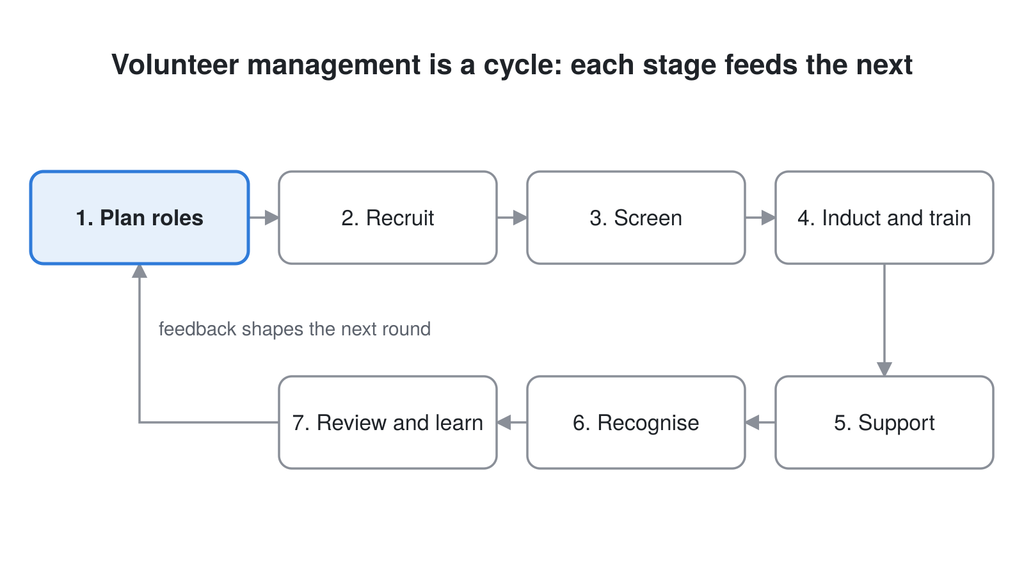
What you learn from reviews, exit conversations and feedback should change how you plan and write your next roles.
Your legal obligations
Volunteers have fewer legal protections than employees, but your charity still owes them real duties. These are the five areas to get right.
1. Work health and safety
Under the model WHS laws, an unpaid volunteer counts as a worker. Whether your charity owes them WHS duties depends on one question: does it employ anyone?
| Your charity | WHS status | What it means |
|---|---|---|
| Employs one or more paid staff and has volunteers | Volunteer organisation, covered by WHS laws | You owe the same health and safety duties to volunteers as to paid staff, including a duty to consult them on safety |
| Volunteers only, no paid staff (contractors such as an auditor don't count) | Volunteer association, not covered by WHS laws | No legal WHS duties, but following them is still good practice and reduces liability risk |
The model WHS laws apply in every state and territory except Victoria, which has its own Occupational Health and Safety Act 2004. Victorian charities should check WorkSafe Victoria's guidance on duties to volunteers.
Volunteers also have duties: to take reasonable care for their own safety, to not harm others, and to follow reasonable safety instructions.
2. Volunteer or employee?
A genuine volunteer works for no financial gain, has no expectation of payment and is free to stop at any time. Reimbursing real out-of-pocket costs, such as travel or meals, does not make someone an employee.
Risk arises when "volunteers" receive regular cash payments, are rostered and required to attend like staff, or do work that would otherwise be paid. If a role looks and feels like a job, the Fair Work Ombudsman may treat it as one, with back-pay and penalties to follow. See Employee, contractor or volunteer?
3. Insurance
Volunteers are generally not covered by workers' compensation, which only covers employees (some emergency service volunteers are an exception). Most charities need three policies:
- Volunteer personal accident insurance, to cover injuries to volunteers
- Public liability insurance, to cover harm a volunteer causes to others
- Directors' and officers' (or association) liability insurance, to cover your board
Every state and territory has laws that protect individual volunteers from personal liability for acts done in good faith. That liability usually shifts to the organisation, which is another reason to hold public liability cover.
4. Screening and child safety
Volunteers who work with children need a Working with Children Check in most states and territories, and rules differ by jurisdiction. Volunteers in aged care, disability (NDIS) and some health settings face extra screening. See Child Safe Standards and Working with Children Checks by state.
5. Privacy and discrimination
Volunteer records contain personal and sometimes sensitive information. The Privacy Act binds charities with turnover above $3 million and all health service providers, but every charity should store records securely and collect only what it needs.
State anti-discrimination laws protect volunteers in some jurisdictions. Select volunteers on their suitability for the role, not on protected attributes.
The National Standards for Volunteer Involvement
The National Standards for Volunteer Involvement are Australia's best-practice benchmark for working with volunteers. They are owned by Volunteering Australia, were refreshed in 2024, and are voluntary: no law requires you to meet them. They scale to any size of organisation, including fully volunteer-run groups.
| Standard | What it asks of your charity | Where this guide covers it |
|---|---|---|
| 1. Volunteering is embedded in leadership, governance and culture | Leaders define who is responsible for volunteers, manage risk and keep proper records | Legal obligations; Policies and records |
| 2. Volunteer participation is championed and modelled | Volunteering is part of your strategy and has a budget and a named manager | Planning roles |
| 3. Volunteer roles are meaningful and tailored | Roles serve your purpose, are written down and are reviewed with volunteers | Planning roles |
| 4. Recruitment is equitable and diversity is valued | Recruitment is planned, inclusive and includes screening in line with the law | Recruiting; Screening |
| 5. Volunteers are supported and developed | Volunteers get induction, training, supervision and support | Onboarding and training; Supervision |
| 6. Volunteer safety and wellbeing is protected | Health and safety, insurance and a complaints process are in place | Legal obligations; Policies and records |
| 7. Volunteers are recognised | Volunteer contribution is measured, reported and acknowledged | Recognition; Measuring impact |
| 8. Policies and practices are continuously improved | Volunteer involvement is reviewed, reported to the board and shaped by volunteer feedback | Measuring impact |
Volunteering Australia publishes free tools to help you apply them, including a gap analysis checklist, an implementation guide and an evidence guide. State and territory volunteering peak bodies (such as Volunteering Victoria and The Centre for Volunteering in NSW) run training and support. See The National Standards for Volunteer Involvement explained.
Planning roles and recruiting volunteers
Good recruitment starts before you advertise. Decide what you need volunteers to do, then write it down.
Write a role description for every position
A one-page role description sets expectations on both sides and is the foundation for screening, induction and supervision. Include:
- the role title and who the volunteer reports to
- the purpose of the role and how it serves your mission
- the main tasks, and what the role does not include
- time commitment, location and whether remote work is possible
- skills, experience and checks required (for example, a Working with Children Check or driver's licence)
- training and support provided
- what the volunteer can expect to gain
Avoid writing volunteer roles that replace paid positions. It creates employment law risk and can damage relationships with staff and unions.
Where to find volunteers
| Channel | Best for | Tip |
|---|---|---|
| Your existing volunteers and supporters | Most roles | Ask current volunteers to bring a friend. Word of mouth is often the strongest channel |
| Your website and social media | Ongoing and flexible roles | Have a clear "Volunteer with us" page with role descriptions and a short sign-up form |
| Volunteer matching sites (such as GoVolunteer) | Reaching new audiences | Write roles from the volunteer's point of view: what they'll do and gain |
| Local volunteer resource centres | Local, face-to-face roles | Many councils and regions have one that refers volunteers for free |
| Corporate volunteering programs | Team days and skilled projects | Be ready with a well-scoped, one-day project |
| Skilled volunteering platforms | Board members and professional skills | Specify the exact skills and time needed |
| Universities and TAFEs | Students seeking experience | Offer a reference and clear learning outcomes |
Make recruitment inclusive
Standard 4 of the National Standards asks charities to build diversity and accessibility into recruitment. In practice, that means offering flexible and short-term roles, covering out-of-pocket costs where possible, using plain language, and asking applicants what adjustments they need. Rising costs, including fuel, are a real barrier for some volunteers, so reimbursing travel can widen your pool.
Screening, onboarding and training
Screen in proportion to risk
Not every role needs a police check. Match your screening to what the volunteer will do and who they will be with.
| Role risk | Example roles | Typical screening |
|---|---|---|
| Low | Event helper, op shop sorting, office admin with no client contact | Application form, short conversation, reference optional |
| Medium | Driver, handling cash, access to donor or client data | Interview, two references, licence or ID check, signed confidentiality agreement |
| High | Working with children, people with disability, older people or other vulnerable clients | All of the above, plus a Working with Children Check, police check or NDIS worker screening as the law requires |
Record what checks you did, when, and when they expire. Set reminders to renew them.
Run a consistent induction
Every new volunteer should complete an induction before their first shift, even if it is only 30 minutes. Cover:
- Your charity's purpose, values and how their role contributes
- Who their supervisor is and how to reach them
- Health and safety: hazards, emergency procedures and how to report an incident
- Code of conduct, confidentiality and privacy
- Child safety or safeguarding procedures, where relevant
- How to raise a concern or make a complaint
- Practical details: rosters, sign-in, expenses and parking
Give new volunteers a buddy for their first few shifts. Check in after two to four weeks to ask how it's going.
Train for the role
Train volunteers for the specific tasks they will do, and refresh training when procedures change. Keep a simple record of who has completed what. Many state peak bodies and councils offer free or low-cost training in areas such as first aid, safeguarding and mental health first aid.
Supervision, recognition and retention
Keeping a volunteer is far cheaper than finding a new one. Retention comes down to three things: clear support, real appreciation and a good experience.
Supervise and support
- Give every volunteer a named contact who checks in regularly, not only when something goes wrong.
- Hold a short review conversation at least once a year. Ask what they enjoy, what frustrates them and whether they want to try something new.
- Handle problems early and fairly. If a volunteer isn't meeting expectations, talk privately, refer back to the role description and agree what will change. Document the conversation.
- If you need to end a volunteer's involvement, follow a written process, give reasons and offer a chance to respond, unless there is a serious safety risk.
Recognise volunteers in ways that matter to them
Recognition works best when it is specific, timely and suited to the person. Some volunteers love public thanks; others would rather a quiet word.
- Thank people personally and mention the difference their work made.
- Share impact stories and numbers in volunteer newsletters.
- Mark key dates: National Volunteer Week (May), International Volunteer Managers Day (5 November) and International Volunteer Day (5 December).
- Offer references, training and opportunities to take on more responsibility.
- Celebrate milestones such as one, five and ten years of service.
Learn from people who leave
When volunteers leave, ask why. A short exit survey or phone call often reveals fixable issues, such as unclear roles, poor communication or rosters that don't suit. Keep the door open: many people return when their circumstances change.
Policies and records every charity needs
You don't need a thick manual. A small charity can cover the essentials in a short volunteer policy plus a handful of forms. Develop them with volunteers, as Standard 1 recommends, and review them every two years.
Core documents
| Document | What it covers | Essential for |
|---|---|---|
| Volunteer policy | Your commitment to volunteers, rights and responsibilities, recruitment, screening, expenses, ending involvement | Every charity with volunteers |
| Role descriptions | Tasks, time, checks and support for each role | Every role |
| Code of conduct | Expected behaviour, boundaries, conflicts of interest | Every charity |
| WHS policy and incident reporting form | Hazards, emergency procedures, how to report injuries and near misses | Every charity (required if you employ staff) |
| Child safe or safeguarding policy | How you protect children and vulnerable people | Any charity working with these groups |
| Complaints and grievance procedure | How volunteers raise concerns and how you respond | Every charity |
| Expenses reimbursement policy | What you will reimburse and how to claim | Any charity that reimburses costs |
| Privacy statement | What volunteer information you collect and how you protect it | Every charity |
Records to keep for each volunteer
- contact and emergency contact details
- role(s), start date and supervisor
- screening checks completed, with check numbers and expiry dates
- induction and training completed
- hours contributed (useful for reporting and grant applications)
- incidents, complaints or performance conversations
A spreadsheet works for a handful of volunteers. Beyond about 20, a volunteer management system or a CRM with a volunteer module saves time, especially for rostering and check expiry reminders. See How to choose a CRM for a small charity.
Measuring and reporting volunteer impact
Measuring volunteer contribution helps you thank volunteers meaningfully, win grants and show your board that the program is worth investing in. Standards 7 and 8 both ask for it.
What to track
| Measure | Why it matters | How to collect it |
|---|---|---|
| Number of active volunteers | Shows reach; the ACNC Annual Information Statement asks for it | Volunteer register |
| Hours contributed | Shows scale of contribution | Sign-in sheets or rostering software |
| Retention rate (share still active after 12 months) | Early warning of problems in your program | Compare register snapshots a year apart |
| Volunteer satisfaction | Predicts retention | A short annual survey |
| Outputs and outcomes delivered by volunteers | Shows what volunteers actually achieve | Program data, such as meals delivered or students mentored |
Putting a dollar value on volunteer time
The most common method is replacement cost: multiply volunteer hours by the hourly wage you would pay someone to do the same work. Use a relevant award rate for each role rather than a single average. State your method whenever you publish the figure.
Charities can choose to recognise the fair value of volunteer services in their financial statements under accounting standard AASB 1058, but most small charities report it as a note or in their annual report instead. Ask your accountant before changing how you report.
Report it
Include volunteer numbers, hours and stories in board reports, your annual report and funder acquittals. Share the results with volunteers too: knowing their impact is one of the most powerful forms of recognition. See Impact measurement for small charities.
Frequently asked questions
Do volunteers need a police check in Australia?
Not always. No general law requires police checks for every volunteer. They are required for some roles, such as aged care and certain disability and education settings, and volunteers working with children usually need a Working with Children Check. For other roles, decide based on risk.
Are volunteers covered by workers' compensation?
Generally no. Workers' compensation covers employees, so most charities buy volunteer personal accident insurance instead. Some emergency service volunteers are covered by specific state schemes.
Can we pay volunteers?
You can reimburse genuine out-of-pocket expenses, such as travel, parking and meals, ideally against receipts or at a set rate. Regular payments, honoraria or allowances that look like wages can turn a volunteer into an employee under the law.
Do WHS laws apply to volunteer-only charities?
Under the model WHS laws, a group made up only of volunteers that employs no one is a volunteer association and is not covered. Once you employ even one person, your duties extend to volunteers as well. Victoria has its own OHS law.
Are the National Standards for Volunteer Involvement mandatory?
No. They are a voluntary best-practice framework owned by Volunteering Australia. Some funders and accreditation schemes refer to them, so meeting them can strengthen applications.
How many volunteers can one coordinator manage?
It depends on how often volunteers work and how much support their roles need. A few dozen regular, high-contact volunteers can be a full-time job, while hundreds of occasional event volunteers might be managed part-time with good systems. Track the hours your coordinator spends and adjust.
Sources
- National Standards for Volunteer Involvement, Volunteering Australia
- Volunteering Statistics: General Social Survey 2025, Volunteering Australia, May 2026
- Volunteers: overview, Safe Work Australia
This guide is general information, not legal advice. Check the rules in your state or territory, and get advice for your circumstances.